
Orientalist Figure by Louis Hottot ‘Jeune Harpiste Arabique
£6,500.00

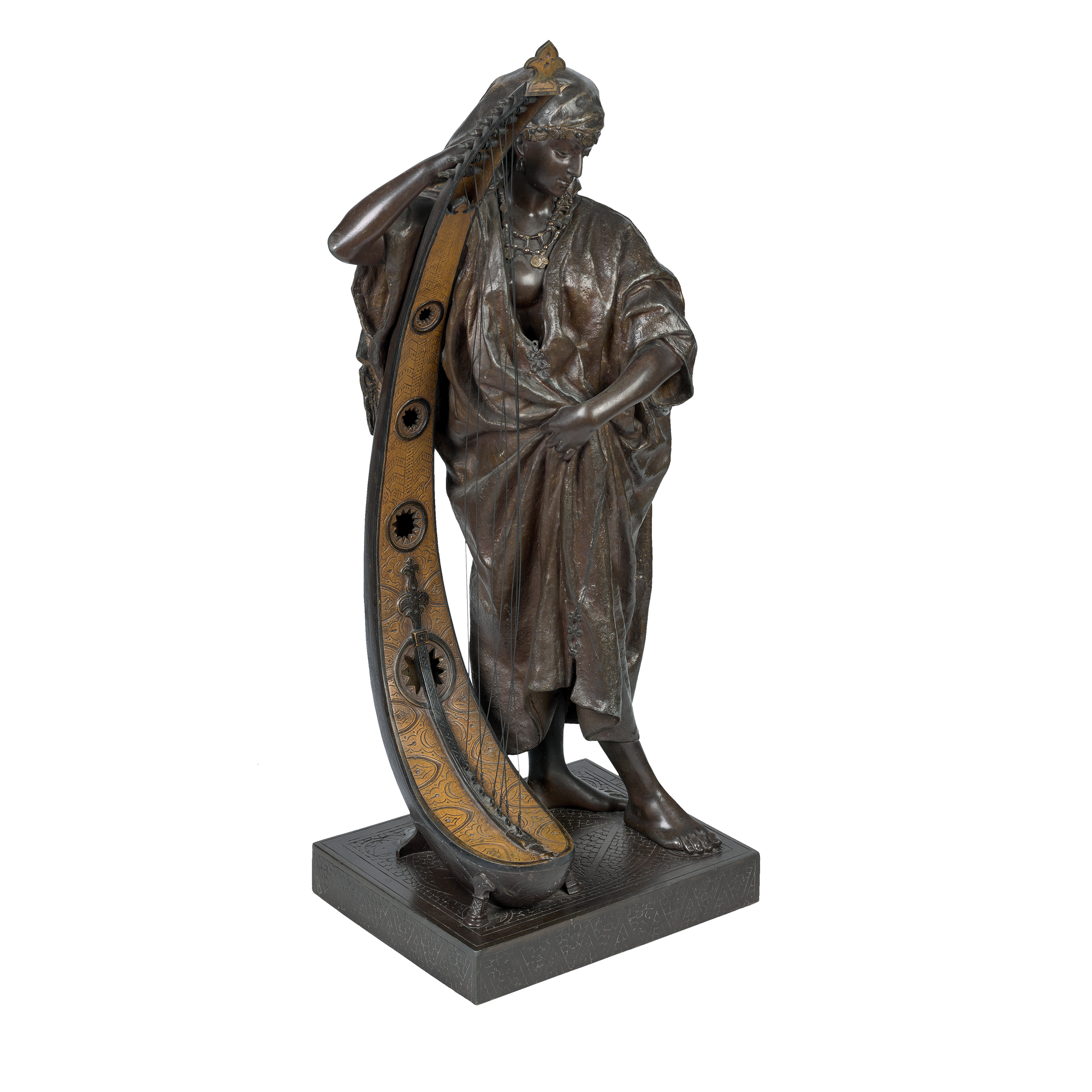


Orientalist figure of Jeune Harpiste Arabique (French 1829-1905) by Louis Hottot. Depicting an Arabic girl wearing traditional costume with coins at both her neck and forehead, standing barefoot on a cobbled pavement. She is holding her harp against her and seems to be lost in thought. The harp is intricately worked with wonderful Oriental design. The square base is signed 'L Hottot'.
Louis Hottot was very much inspired by Oriental and Arabic scenes. It is most probable that like so many of his contemporaries, he travelled and explored North Africa and the Middle East. This unexplored, exotic part of the world provided unlimited inspiration for artists as it fired the imagination and simulated the senses, being so rich in colour, smell, sound and culture.
His works are of great beauty and romance, evoking a completely different world to that of nineteenth century Paris. He manages to capture the romantic flavours of Arabia, of young exotic dancers, Eastern music and mystery, of Oriental trade and colour. His most noteworthy pieces include 'Egyptian Girl' (1885- Hottot's first year at the salon), 'Phoebe and Echo' (1888), 'Arabic Vendor, Almee Du Caire' (1887), 'Jeune Harpiste Arabique' and several other works depicting young Arabic and Oriental girls.
However, Hottot didn't restrict himself totally to sculpting Eastern scenes. His other works include a plaster of 'Alexander III', 'Napoleon I', and 'Bust Of An Italian Girl'.
Hottot submitted works to the Paris Salon between 1885 and 1898. His sculptures were cast in bronze, spelter, marble, and composite.
The piece Jeune Harpiste Arabique is a fine example of his work, combining great beauty, elegance and originality. Hottot used a mixture of bronze (the harp), spelter (the girl and base) and cold painted enamel (on the surface of the harp).
Date: 1885-1898
Origin: France
Materials: Bronze, Enamel, Spelter
Dimensions: 30.5 Inch (H) 12 Inch (W) 12 Inch (D)

Have items to sell?
Contact us and speak to an expert today for your FREE home valuation.
